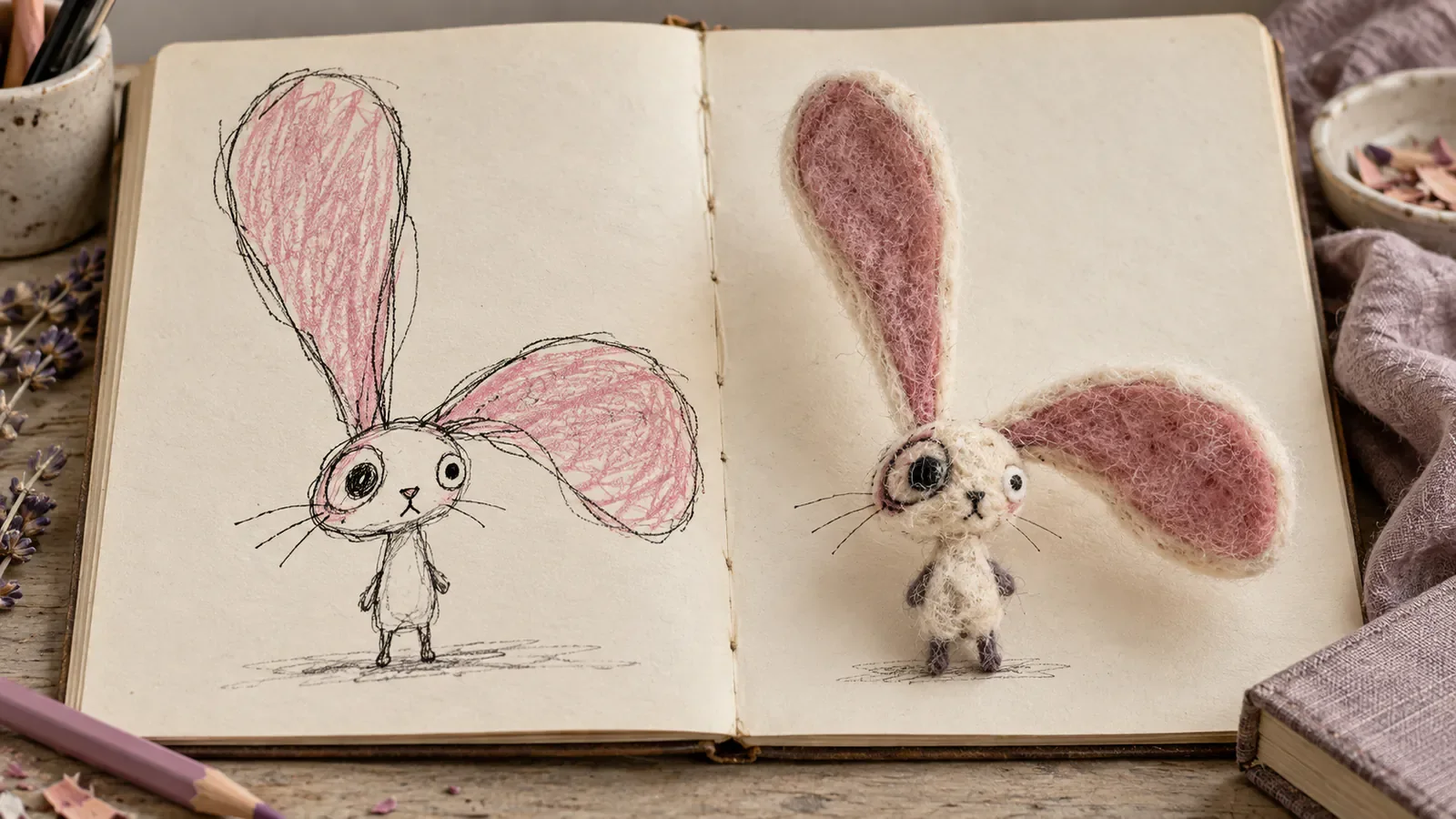
Look at a doodle you almost deleted. The line may wobble, one eye may sit too high, or the ears may take up most of the page. Those details can be more useful than technical perfection because they give you an immediate way to recognize the character.
Many memorable characters can be described in one sentence: the rabbit that is almost entirely ears, the cat shaped like a loaf of bread, or the creature whose tail takes up more space than its body.
These drawings are not memorable despite their strange proportions. They are memorable because of them.
Recognition depends on a few strong decisions
When a drawing is small, the eye cannot process every line equally. It looks first for broad shape, contrast, color, and repeated features. That is why a simple doodle with one exaggerated characteristic can be easier to recognize than a detailed character without a clear silhouette.
The rabbit above needs very little information. Two long pink shapes, a tiny white body, dot eyes, and a small mouth are enough. If the ears were shortened to look more realistic, the drawing would become more ordinary and less specific.
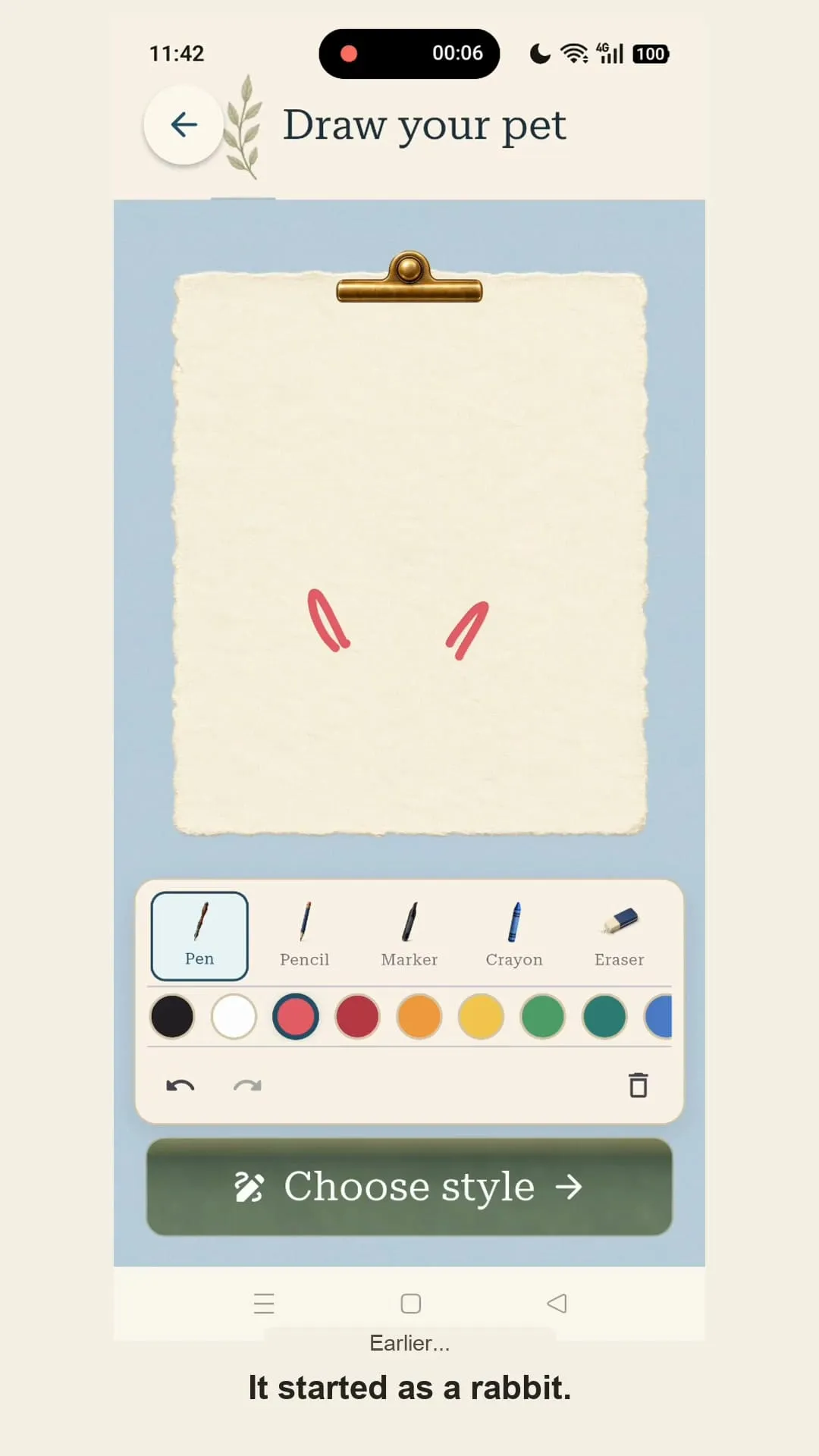
Even the first marks establish the idea that the ears—not the body—will dominate the character.
“Correcting” a doodle can remove its personality
Creative tools often make rough work smoother, more symmetrical, and more polished. That can be useful, but polish is not the same as identity.
If a lopsided eye is the joke, straightening it changes the character. If a one-line tail created an impossible spiral, replacing it with a normal tail solves the anatomy and loses the story. If a child drew legs at four different angles, perfect proportions may erase the energy of the original.
Before refining your drawing, ask which irregularity you would miss if it disappeared. Protect that feature first; clean up only what makes the character harder to read.
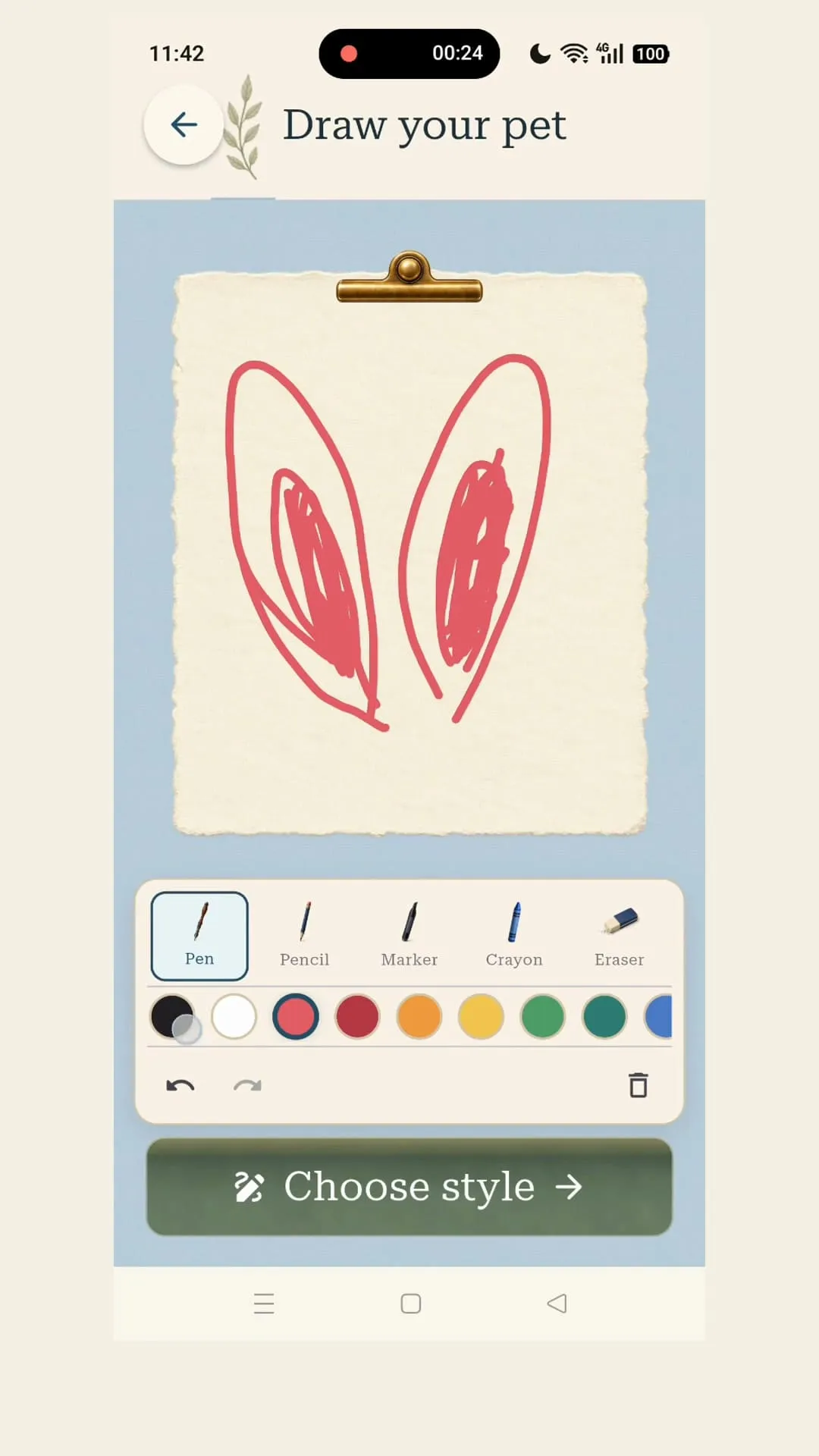
The ears are deliberately too large and not perfectly symmetrical. Correcting them would remove the joke.
A useful character test
Try describing your doodle without naming its species. For example:
- “two huge pink ears with a tiny body underneath”;
- “a long yellow shape with cat ears”;
- “a round purple creature with one bent leg”;
- “a small animal attached to an enormous curled tail.”
If the description immediately suggests the drawing, you have found its defining feature. That feature should guide any redraw, animation, model, sticker, or digital interpretation.
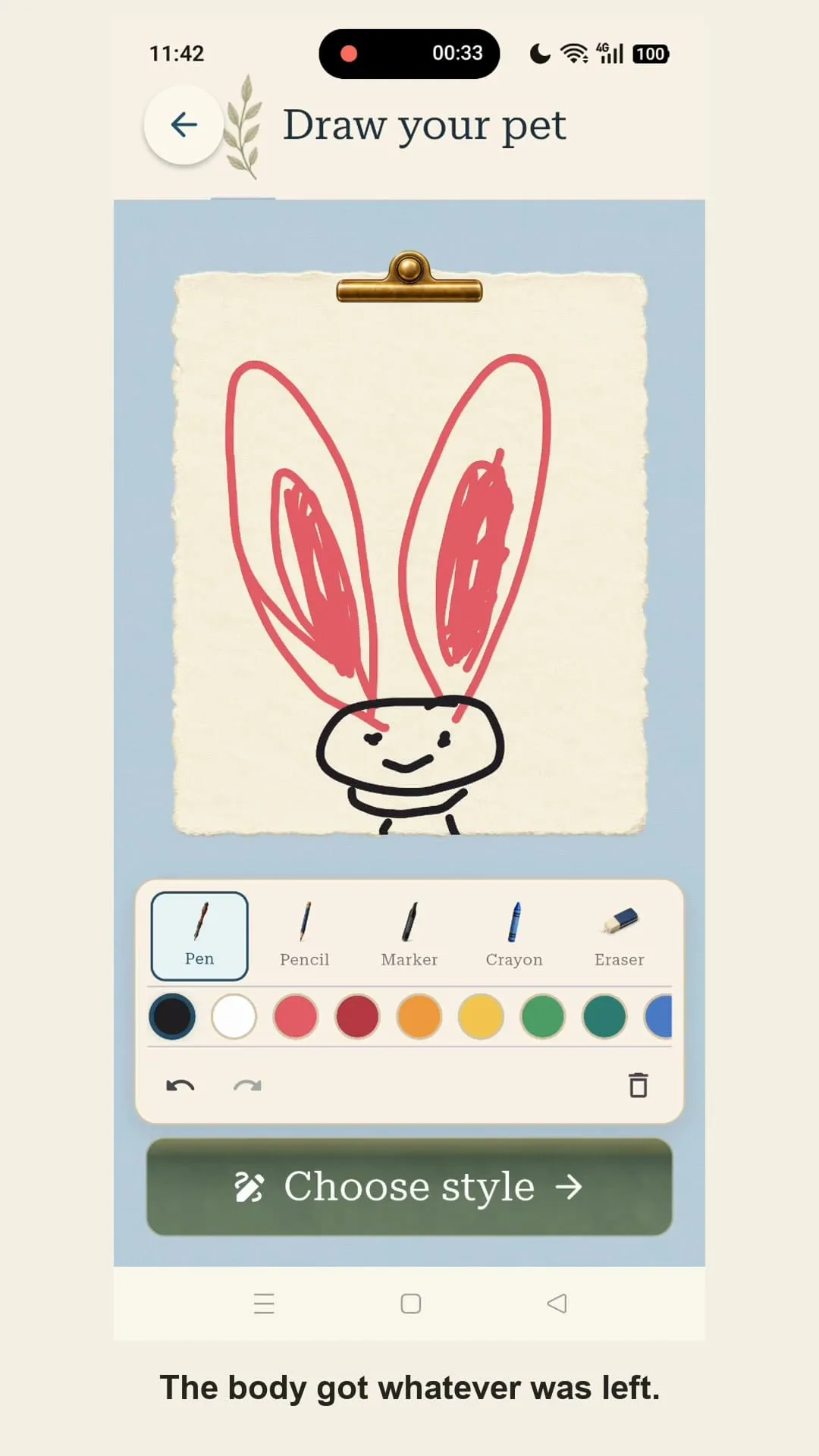
The completed doodle is recognizable through one strong proportion: almost all ears, very little rabbit.
Simplicity helps a character travel between formats
A drawing may begin on paper and later appear as a profile image, sticker, animation, game character, or screen pet. Each format changes the available size, motion, and detail.
Strong silhouettes and clear color relationships survive those changes. Tiny textures and subtle pencil marks may not. This does not mean every drawing should be simplified aggressively; it means the most important idea should remain visible even when the format changes.
How PetPip approaches the transformation
PetPip—made by the team publishing this blog—lets your drawing become the starting point for a personal screen pet. AI generation is not exact tracing: it can reinterpret lines, materials, colors, and proportions.
The more useful question is whether the new companion keeps the visual decision that made the source memorable. The long-eared rabbit should still be read through its ears. A curled-tail creature should not return with an ordinary straight tail and expect the connection to feel unchanged.
After creation, the character can hatch, receive care, respond to touch, and grow inside PetPip. That continuing role changes the design problem: the pet must remain recognizable not only in one large image, but also when it is moving or appearing at a smaller screen size.
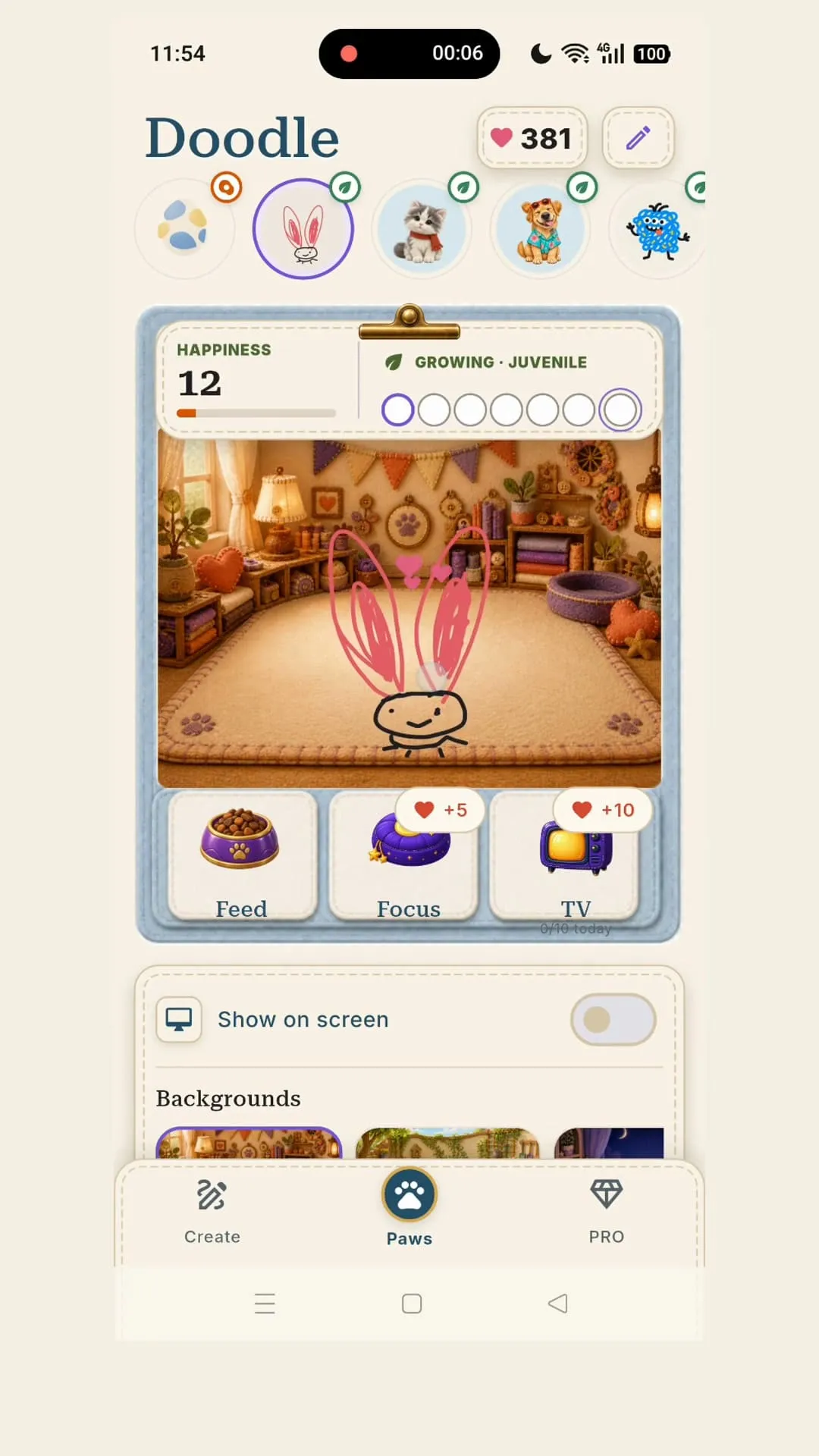
The screen-pet interpretation keeps the oversized ears visible even when the character is shown inside a smaller interface.
Make the important “mistake” easier to see
If you want to use your doodle in a creative tool:
- Keep one character clearly separated from the background.
- Darken faint outlines that are essential to the shape.
- Preserve the full ears, tail, legs, or accessories inside the frame.
- Use enough contrast for the main colors to remain distinct.
- Keep the original drawing before editing or generating anything new.
Do not redraw the life out of it. Save the original first, then make only the changes needed for the idea to remain clear. A strange proportion or uneven line may be the shortest path to a character that belongs to nobody else.